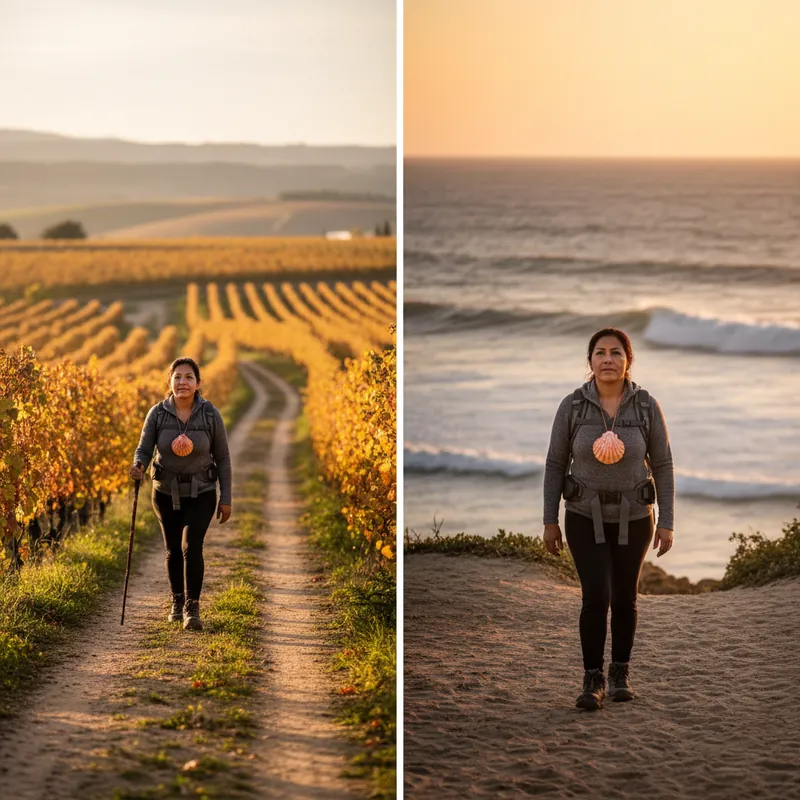
French vs Portuguese Camino for Mexicans
Updated May 2026. By FlightsMX Editorial Team · 9 min read · Verified with Cathedral of Santiago + Federación Española.
Bottom line: For your first Camino as a Mexican: Portuguese Camino (260 km, 13 days, ~$US 1,700-2,300 total) — shorter, coastal, less saturated. For complete traditional experience with international pilgrim community: French Camino (780 km, 32 days, ~$US 2,400-3,200) — the medieval classic, more historic, better for extended spiritual retreat.
Head-to-head table
| Criterion | French | Portuguese |
|---|---|---|
| Distance | 780 km | 260 km (Porto-Santiago) |
| Standard stages | 32 days | 13 days (from Porto) |
| Start point | Saint-Jean-Pied-de-Port (France) | Porto or Lisbon (Portugal) |
| End | Santiago de Compostela | Santiago de Compostela |
| Total cost Mexican | $US 2,400-3,200 | $US 1,700-2,300 |
| Scenery | Pyrenees → Meseta → Inner Galicia | Atlantic coast + Portuguese forests |
| Difficulty | Medium-high (first-day Pyrenees) | Low-medium |
| Pilgrim community | International very active | More solitary |
| Municipal albergues | Dense, every 5-10 km | Every 15-20 km |
| Best month (climate) | Sep-Oct | Mar-May, Sep-Oct |
| WiFi coverage | Good 90% route | Excellent 95% route |
| Languages spoken | Spanish, English, German, French | Portuguese + Spanish (mutually understandable) |
Duration and kilometers — work time needed
French Camino (780 km standard)
- Daily distance average: 25 km
- Walking days: 30-32
- Rest days recommended: 2-3 (Burgos, León, Sarria)
- Total with rest: 32-35 days
- Pre/post buffer: +3-5 days (jet lag, MAD arrival, post-Compostela)
- Total off-work time: 5-6 weeks
Portuguese Camino (260 km from Porto)
- Daily average: 20-22 km
- Walking days: 12-14
- Rest days: 1
- Total: 13-15 days
- Pre/post buffer: +3-4 days
- Total off-work: 2.5-3 weeks
For the Mexican with limited vacation
- 2 weeks vacation → Portuguese from Porto (perfect fit)
- 5-6 weeks (sabbatical, retirement, freelance) → Full French Camino
- 4-5 weeks → Portuguese complete (Lisbon) or French from Sarria (last 100 km in 5 days + 1 week rest)
Cost comparison peso-by-peso
For Mexican traveling solo, September-October 2026:
| Component | French Camino | Portuguese (Porto) |
|---|---|---|
| MEX-MAD round-trip flight | $US 750-950 | $US 750-950 |
| Transfer to start point | $US 60-70 (bus to SJPP) | $US 60-120 (Porto bus/flight) |
| Albergues 32 vs. 13 nights | €350-500 ($US 380-540) | €145-200 ($US 160-215) |
| Food 32 vs. 13 days | €600-800 ($US 650-865) | €240-325 ($US 260-350) |
| Return to MAD | $US 50-80 | $US 50-80 |
| Credencial + sellos | €5-10 | €5-10 |
| Gear (if new) | $US 300-450 | $US 250-380 |
| Buffer contingencies | +$US 200 | +$US 130 |
| TOTAL | $US 2,395-3,180 | $US 1,665-2,265 |
Difference: ~$US 700-900 favoring Portuguese.
Savings tip — parish albergues
- French 80% parochial + 20% private: $US 2,200-2,700
- Portuguese 80% parochial + 20% private: $US 1,500-1,900
Parochial albergues are donation (€5-10 suggested). Basic but sufficient. More spiritually authentic.
Scenery and day-by-day experience
French Camino — the medieval classic
Phase 1 (days 1-5): Pyrenees + Navarra
- Day 1 Saint-Jean → Roncesvalles: Pyrenees crossing, hardest day physically (1,400m elevation, 27 km)
- Pamplona: San Fermín bull-running (July), Basque-Navarran tapas
- Estella, Logroño: Rioja wines
Phase 2 (days 6-13): Meseta + Burgos + León
- The Meseta: treeless plain, 4-5 days monotonous but contemplative landscape
- Burgos: Gothic Cathedral UNESCO
- León: cocido leonés stew, stained glass
Phase 3 (days 14-21): Bierzo + Galicia
- O Cebreiro: Celtic villages in Galician mountain
- Sarria: “Compostela point” (final 100km starts here)
- Lugo: Roman wall
Phase 4 (days 22-32): Galicia to Santiago
- Smaller villages, more rustic accommodations
- Pilgrim density increases (Sarria starters)
- Arrival Plaza del Obradoiro, Cathedral, Pilgrim’s Mass
Portuguese Camino — coastal + forests
Coastal version (most popular):
- Day 1 Porto → Vila do Conde (28 km Atlantic coast)
- Days 2-4: fishing villages, ocean views, fresh seafood
- Days 5-7: Pontevedra (must-stop), Galician begins
- Days 8-12: Padrón (origin of Santiago name), eucalyptus forests
- Day 13: arrival in Santiago
Which is “more beautiful” — subjective
- For nature/sea lovers: Portuguese coastal
- For history/medieval architecture lovers: French
- For spiritual retreat + pilgrim community: French
- For silent solo escape: Portuguese central
Physical difficulty — relevant for coastal vs. high-altitude Mexicans
French Camino
Difficulty peaks:
- Day 1 Pyrenees (1,400m elevation gain) — hardest day of Camino
- O Cebreiro Galicia mountains (days 22-23)
- Meseta days — psychologically tough (monotonous landscape) but physically easy
For CDMX Mexicans (2,240m altitude): Pyrenees climb to 1,400m → already acclimatized to altitude, advantage. Effort is cardiovascular, not hypoxic.
For coastal Mexicans (Cancún, Veracruz, Acapulco — sea level): Pyrenees can be tough. Train 6-8 weeks before with hill walks (Tepoztlán, Xochicalco, Mineral del Chico).
Portuguese Camino
Difficulty peaks:
- Modest climbs leaving Porto (not demanding)
- Galician forests have moderate slopes
- Generally 70-80% easier physically than French
For absolute beginners: Portuguese Camino is the right choice.
Age and physical condition
- 20s-30s: any Camino, fast recovery
- 40s-50s: both possible, but training recommended for French
- 60s+: Portuguese more realistic; or French from Sarria (final 100 km in 5 easy days)
Which Camino suits your situation
”My first Camino”
→ Portuguese from Porto — perfect balance duration/cost/difficulty/community
”I have 5+ weeks and want full medieval experience”
→ French (780 km) — the canonical classic, unmatched pilgrim community
”Just want Compostela in minimum time”
→ Sarria → Santiago (French last 100 km) — 5 days, ~$US 800 total
”Senior adult / knee problems / past injury”
→ Portuguese coastal — soft terrain, comfortable accommodations. Or bike (300 km Portuguese in 7-10 days).
”Going with family with kids (8-15 years)”
→ Portuguese Porto — short, kid-friendly hospitality, kids handle 20km/day with stops
”Spiritual pilgrim + time”
→ French, consider full parochial albergue (donation, authentic spiritual vibe)
“Going with non-religious friends”
→ Portuguese — more relaxed, less saturated with “heavy religious vibe”
FAQs
Can I combine parts of both Caminos?
Yes — some pilgrims do Lisbon-Porto (Portuguese central), then cross to Vigo and do English Camino to Santiago. It’s a variant. Or Sarria-Santiago first, then Porto-Santiago next year.
Does Compostela equal in both Caminos?
Yes. Any official Camino route with last 100 km on foot / 200 km bike sealed = valid Compostela. Certificate doesn’t distinguish French vs. Portuguese vs. English vs. Northern.
Which has better food?
- French: Rioja wines, ham, cocido leonés, manchego cheese, Galicia seafood
- Portuguese: bacalhau, francesinha (Porto sandwich), vinho verde, Atlantic seafood, pastéis de nata
Both excellent — Portuguese seafood wins, French cheese and wine win.
Where to sleep if albergues are full?
- Plan A: arrive early (13:00) at next stage
- Plan B: walk 5-10 km more to next village
- Plan C: Booking.com pensión ~€30-50 — all villages have at least one
Need to know French/Portuguese?
NO. Spanish works in both:
- In France (leaving SJPP): basic French helpful but many pilgrim shops speak Spanish/English
- In Galicia (final French): Galician ≈ Portuguese + Spanish = mutually understandable
- In Portugal: Portuguese ≈ understandable for Mexican
Worth Camino outside Jubilee Year?
Yes. Jubilee Year 2025 observance extended through Dec 2026, but Camino is valid all year. Difference: Jubilee Year has official plenary indulgence Compostela (important for practicing Catholics).
Sources
- Cathedral of Santiago — Pilgrim’s Office (May 2026)
- Federación Española del Camino (May 2026)
- Caminho Português — Portuguese Federation (May 2026)
- INM Mexico — Consular assistance pilgrims (May 2026)
Related reading
- Camino de Santiago from Mexico: total cost
- Compostela certificate guide
- Schengen 90/180 for Mexicans
- Live MEX-MAD fares
Edited by FlightsMX Editorial Team. Buen Camino, pilgrim.