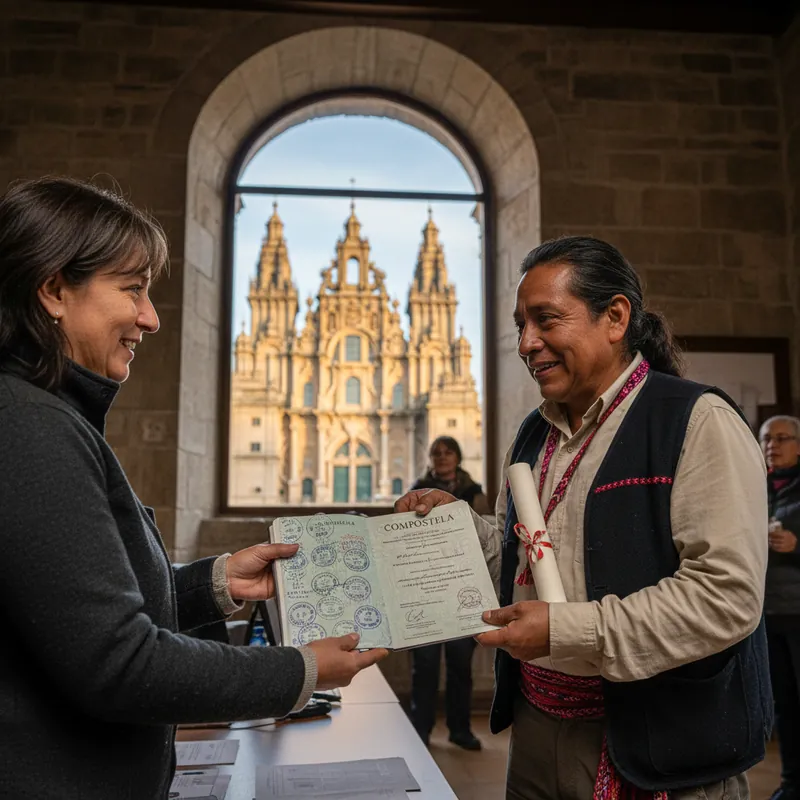
Compostela: getting the certificate as a Mexican
Updated May 2026. By FlightsMX Editorial Team · 7 min read · Verified with Pilgrim’s Office of Santiago + Cathedral of Santiago de Compostela.
Bottom line: To get the Compostela (official Camino certificate) as a Mexican: walk the last 100 km of French Camino from Sarria (or equivalent on other routes) on foot (or 200 km biking), collect minimum 2 stamps per day in your Pilgrim Credential, and present yourself at the Pilgrim’s Office, Rúa Carretas 33 in Santiago. Certificate is FREE (extended Jubilee Year through Dec 2026 gives plenary indulgence).
In this guide
- What is the Compostela vs. Distance Certificate
- Official 2026 requirements
- The Pilgrim Credential — where to get it in Mexico
- Stamps: when, where, how many
- Pilgrim’s Office: how to get there
- Extended Jubilee Year 2025-2026
- FAQs
What is the Compostela vs. Distance Certificate {#what}
The Compostela (free, in Latin)
- Official certificate issued by Cathedral of Santiago since 13th century
- Documents you’ve completed pilgrimage to St. James’s tomb
- Declared motivation: religious or spiritual
- In Jubilee Year (last: 2025, extended to Dec 2026): includes plenary indulgence for practicing Catholics
- Name written in Latin (“Maria Ferdinanda Castelius” not “María Fernanda Castillo”)
- Cost: FREE
The Distance Certificate (€3)
- Documents kilometers walked without religious attribution
- Declared motivation: cultural, sporting, touristic
- Similar design but distinguishable
- Good option if not Catholic or want no religious attribution
- Cost: €3
Both certificates issued in the same Pilgrim’s Office. Only difference is motivation declared.
Compostela by Bike / Horse
- On foot: 100 km minimum
- Biking: 200 km minimum
- On horseback: 100 km minimum
- Wheelchair (assisted): 100 km minimum, without continuous help required
Rules updated 2024 for disability inclusion.
Official 2026 requirements {#requirements}
1. Minimum distance
- On foot: last 100 km to Santiago (typically Sarria in French Camino, Tui in Portuguese)
- Biking: last 200 km
- Continuously: can’t skip stages within the last stretch
2. Pilgrim Credential with stamps
- Official Credential stamped with minimum 2 stamps per day in last 100 km on foot (1 stamp per day if biking)
- Stamps from: municipal/parochial albergues, bars, churches, tourist offices
3. Declared motivation
- “Religious / spiritual” → Compostela
- “Cultural / sporting” → Distance Certificate
4. ID document
- Mexican passport (yes, valid — no Spanish passport needed)
- INE (optional, secondary)
5. Physical arrival in Santiago
- Must physically come to Pilgrim’s Office — not mailed
The Pilgrim Credential — where to get it in Mexico {#credential}
Option 1: In Mexico before traveling (recommended)
Places in CDMX:
- CDMX Metropolitan Cathedral (Centro): ask in sacristy about pilgrim credentials
- San Hipólito Church (Historic Center): traditionally sell credentials
- Templo Mayor Tlatelolco: occasionally available
In Guadalajara:
- Guadalajara Cathedral: via parish office
In Monterrey:
- Monterrey Metropolitan Cathedral: parish office
Cost: Free or donation €5-10 / MXN $150-200
Option 2: Online before traveling
Official sites:
- Caminosantiago.org — Spanish federation, sends international credential
- Federación Española de Asociaciones de Amigos del Camino
Cost: €5-10 + international shipping (~€20) Time: 2-3 weeks
Option 3: At Camino start (most common)
French Camino:
- Saint-Jean-Pied-de-Port (France) — tourist office and municipal albergues: €2
- Roncesvalles (Spain) — municipal albergue or cathedral: €2
- Pamplona — Jesús y María albergue: €2
Portuguese Camino:
- Porto Cathedral: €2-3
- Lisbon Cathedral (if starting from Lisbon): €2-3
Sarria (French Camino last 100 km):
- Sarria tourist office: €2
- Sarria municipal albergue: €2
What the Credential should contain
- Your name (identical to passport)
- Nationality: México
- Camino start date
- Space for stamps (minimum 30 slots)
- Credential number (international registry)
Stamps: when, where, how many {#stamps}
Rule 2026 (Cathedral of Santiago)
- Before last 100 km: 1 stamp per day sufficient
- Last 100 km: minimum 2 stamps per day
- One exception: rest by documented illness (with medical receipt) allows skipping stamp but not stage
Where to get stamps
Official places:
- Municipal and parochial albergues — automatic stamp at check-in
- Private albergues — stamp given to pilgrims
- Cathedrals and churches — ask in sacristy
- Tourist offices — yes give stamps
- Bars and cafes on Camino — many have own stamp (free with consumption or sometimes free)
- Pilgrim-friendly shops — some give stamps
Stamping time:
- Morning stamp: when leaving albergue + stamp in bar at lunch (10-12am)
- Afternoon stamp: check-in next albergue + stamp in bar/restaurant (17-20pm)
Tips for perfect stamps
- Don’t wait until end — collect morning + afternoon stamps systematically
- Protect the book — Ziploc bag protects from rain
- Broken stamps don’t count — if stamp falls badly, ask for another
- Falsified stamps = invalidated pilgrimage — Pilgrim’s Office detects them
Pilgrim’s Office: how to get there {#office}
Location
Rúa Carretas 33, Santiago de Compostela
- 200m from Plaza del Obradoiro (Cathedral)
- 5 minutes walking from most central accommodations
- Google Maps: “Oficina del Peregrino Santiago”
Hours
- Monday-Sunday: 09:00-19:00 (summer peak)
- Monday-Sunday: 09:00-17:00 (winter)
- Holidays: reduced hours (verify specific day)
How the process works
- Arrive early (9-10am) — peak lines can be long (Easter, July-August, late Sept-Oct)
- Take number at automatic kiosk on entry
- Wait your turn (10-30 min in peak)
- Present your Credential + Mexican passport to clerk
- Declare motivation: “religious/spiritual” for Compostela, “cultural/sporting” for Distance Certificate
- Clerk hands you your Compostela in Latin, in parchment-style writing
- Optional: buy protective tube for your Compostela (€2-3) — protects for return to Mexico
Pilgrim’s Mass
- Daily 12:00pm in the Cathedral
- Pilgrims arriving that day are announced by country and origin
- If arriving the day before, your name is included in next day’s Mass
- Recommended — emotional culmination of pilgrimage
Botafumeiro (great incensary)
- Doesn’t operate every day
- Operates on special Sundays, religious dates, by large donation from pilgrim groups
- Check calendar at catedraldesantiago.es the week of your arrival
Extended Jubilee Year 2025-2026 {#jubilee}
What is the Jubilee Year
The Compostelan Holy Year (Jubilee) is when July 25 (St. James Feast Day) falls on Sunday. Last was 2021, next will be 2027 and then 2032.
BUT: Cathedral of Santiago extended Jubilee observance from 2025 to December 2026, by special circumstances approved by the Holy See.
What the Jubilee Year gives Catholic pilgrim
- Plenary indulgence — temporal forgiveness of penalties for confessed sins
- Holy Door open at Cathedral (enter through it, not normal door)
- Confession + communion in Santiago within 15 days pre/post pilgrimage
- Pray for Pope’s intentions during pilgrimage
For non-Catholic pilgrims
The Jubilee Year still opens the Holy Door of the Cathedral and spiritual atmosphere is marked. Plenary indulgence is for practicing Catholics only.
How to take advantage of extended Jubilee
- Confess before your pilgrimage (in Mexico with your priest, or at Pamplona/Burgos/León on Camino)
- Take communion in Santiago within 15-day range
- Pray for Pope Francis / Pope Pius intentions during pilgrimage
- Pass through Holy Door upon arrival at Cathedral
- If all completed: your Compostela carries plenary indulgence
FAQs {#faq}
Can I get the Compostela if I only walk the last day (10 km)?
NO. Minimum requirement: last 100 km on foot continuously. Sarria (in French Camino) is the standard starting point for last 100 km. From Sarria, you have 5 days walking to Santiago.
Does my name stay registered forever?
Yes. Compostelas are registered in Santiago’s ecclesiastical archive (modern Codex Calixtinus). You can consult your registration online years later.
How much does the “Caminera” cost?
- Compostela: FREE
- Distance Certificate: €3
- Protective tube: €2-3 (optional but recommended to bring to Mexico)
- Large decorative diploma with frame: €15-30 (optional, in tourist shops)
Can I get Compostela “online” if I walked the 100 km but didn’t reach Santiago?
NO. Pilgrim’s Office requires physical presence. The only exceptional case is documented illness or accident; consult Cathedral directly.
My Mexican passport is close to expiring — can I get Compostela?
Yes, while your passport has 6+ months validity when arriving in Santiago. Clerk only verifies passport is valid.
Does the Compostela equal in 3 Caminos (French, Portuguese, English)?
YES. All official Caminos recognized by the Cathedral lead to same Compostela. Distinction is only the route taken.
Can I get Compostela as a minor?
Yes. Children 12+ with accompanying parent. Compostela arrives “junior” but valid. Children under 12 with parent: family receives “family” Compostela.
Sources
- Cathedral of Santiago — Pilgrim’s Office (May 2026)
- Cathedral of Santiago — Extended Jubilee Year (May 2026)
- Federación Española del Camino (May 2026)
- Mexican Episcopal Conference — Pilgrimage communication (May 2026)
- INM Mexico — Pilgrim consular assistance in Spain (May 2026)
Related reading
- Camino de Santiago from Mexico: total cost
- French vs Portuguese Camino for Mexicans
- Schengen 90/180 for Mexicans
- Live MEX-MAD fares
Edited by FlightsMX Editorial Team. ¡Ultreia y suseia, pilgrim!